
The Complete Mercedes E-Class W213 and W214 Steering Wheel Guide
How to specify a custom steering wheel for a Mercedes-Benz E-Class W213 or W214: fitment checks, the functions you can keep, materials and installation.
Read More →Guide · 10/5/2026
How to specify a custom steering wheel for a Mercedes-Benz A-Class from W176 to W177, including the A35 and A45: fitment, materials and installation.
Mercedes built the A-Class to bring younger buyers into the brand, and it worked. Many of these cars are first Mercedes, kept tidy and driven daily. The wheel is where the daily part shows. A rim that has gone slick lets down a cabin that still looks fresh. A custom Mercedes-Benz A-Class steering wheel restores that surface and nothing else has to change.
Two generations dominate the used market, and the AMG versions add their own wheel hardware on top. Find your row below, then let us confirm the fine detail.
| Chassis | Model and typical years | What usually matters |
|---|---|---|
| W176 | A-Class, 2012 to 2018 | Older button frame and a different airbag connector |
| W177 | A-Class, 2018 onwards | MBUX era, different centre and spoke layout |
| A35 / A45 | AMG versions of the above | Sport airbag cover, heavier padding and paddle cut-outs |
A Mercedes-Benz A-Class steering wheel cannot be shared between those generations. The centre and the button cluster changed when MBUX arrived, which is why the chassis code comes first.
Compact Mercedes cars get used for everything. Many of them are a first Mercedes, and a Mercedes-Benz A-Class steering wheel is the change that shows most. The school run, the station car park, the supermarket, the long weekend trip. The variety wears the leather at nine and three faster than motorway mileage ever would, and the shine appears long before the seats look tired.
Grip and temperature then decide the material. Perforated Nappa keeps the palms dry in summer and warms quickly with the seat heating on. Matte forged carbon suits the upper and lower rim where hands never rest. Red stitching is the detail most A35 and A45 owners ask for, because it echoes the AMG trim. A W177 cabin is dominated by screens, so the wheel is one of the few parts you handle every day. The effect is bigger than it looks on paper.
Four finishes cover almost every A-Class order we build. Each Mercedes-Benz A-Class steering wheel starts from how the car is used. The grid compares how each behaves over years of daily use.
Forged carbon has a marbled surface rather than a woven one, and a matte coat keeps glare down. It hides fingerprints far better than a gloss finish, which matters on a car parked outside all day. Keep it to the upper and lower rim and leave the grips to leather. The matte coat also stays cooler to the touch than a polished surface after the car has stood in the sun.
Perforated Nappa adds ventilation exactly where the hands sit. It keeps the factory look while being easier to live with than suede, and a damp cloth handles most marks.
Smooth Nappa is the closest match to what Mercedes fits itself, so the wheel never looks added. It is also the softest option over a long drive and the simplest to keep clean.
Alcantara gives the strongest grip and reflects the least light. Bare hands leave oils in the nap, so brush it gently every few weeks. Enthusiastic drivers usually consider that a fair exchange.
| Finish | How it feels | Care | Suits |
|---|---|---|---|
| Matte forged carbon | Restrained, low sheen | Wipe over | Cars parked outside |
| Perforated Nappa | Cool and dry | Balm twice yearly | Daily use, warm climates |
| Smooth Nappa | Softest of the four | Damp cloth | Long journeys, factory look |
| Alcantara grips | Firmest grip | Brush occasionally | Spirited driving |
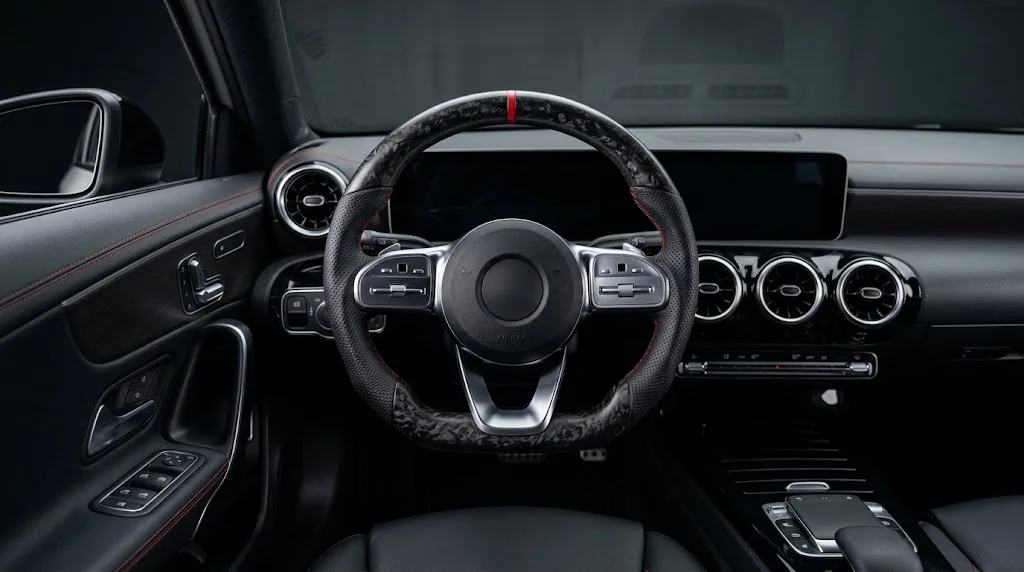
Four things settle it. Send the chassis number and the options list. Add a daylight image of the wheel face, and an image of the rear with the airbag out. Whether a Mercedes-Benz A-Class steering wheel suits your car turns on those details rather than on the badge.
That set shows us the spoke profile, the button cluster and the plug shape. AMG cars carry their own airbag cover and paddle hardware, so the trim level matters here. We cut nothing until the match is confirmed, and we will ask for a sharper image rather than assume.
A working switch should stay working. We reuse the frame and loom already fitted to your car.
| Function | Typical outcome |
|---|---|
| Airbag | Original module normally reused; cover built to suit it |
| Touch control buttons | Retained when the original button frame is reused |
| Paddle shifters | Retained on cars that have them; cut-outs specified at order |
| Heated rim | Depends on the heating element and trim; confirm first |
| Driver assistance | Depends on the hands-on detection fitted to the original wheel |
The heating mat and the hands-on sensor sit behind the rim, so each needs its own photograph. Neither can be judged from the front face.
Keeping your own wheel leaves every electronic part untouched, because only the rim is rebuilt. The frame, the loom and the paddles all stay as Mercedes made them.
A new core is the alternative route, and the factory wheel stays boxed up in the garage. It suits a leased car that must go back to standard, or an owner planning to sell later. With a W176, used wheels are easy to find, so a donor is usually cheaper.
Matte forged carbon with perforated Nappa is the pairing that suits a compact Mercedes. Carbon sits across the top and bottom of the rim, with perforated leather on the grips. Red stitching then lifts a black cabin without turning it loud.
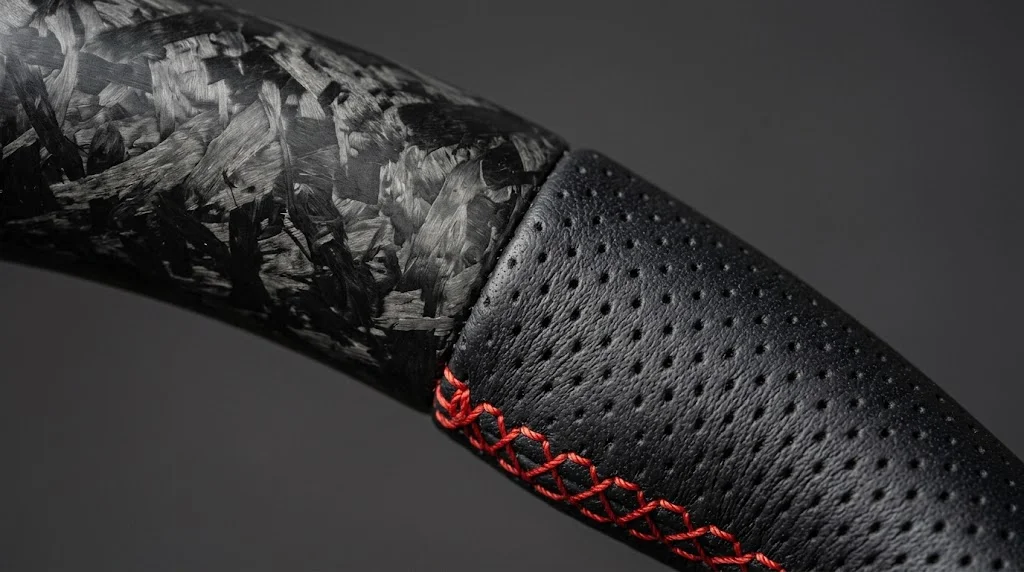
A round rim keeps the wheel even through every input, which suits a car used mostly around town. A flat lower section frees a little knee room and matches the AMG look. Neither shape alters the steering itself, so pick on comfort and on how you want the cabin to read.
Give the airbag work to someone qualified. Isolate the battery and let the car shut down completely before undoing anything. Follow Mercedes procedure for your chassis rather than a generic guide. Place the module on something soft, and set the centre fastener to the figure in the workshop manual. Nothing else should be used for that value. Ask the technician to photograph the airbag connector before it is unplugged, because that image settles most compatibility questions at once.
Afterwards, drive a short distance and check that the rim is centred. Work through every button, the paddles if fitted, and the horn. A warning lamp that remains on means the car needs a scan before further driving.
Modification and warranty are often confused. An aftermarket steering wheel does not automatically void a vehicle warranty under U.S. federal warranty law, but warranty coverage can still depend on whether the modification caused the specific failure being claimed.
Coding questions arrive with most A-Class enquiries. If the factory module, loom and vehicle-specific parts all stay in place, extra coding may be unnecessary. A module from another generation is a different case, and the control unit may then need to learn what is present.
Because that differs between cars, we treat coding as a possible step rather than a certainty. Send the chassis number plus images of both electronic units, and we will say whether a workshop trip looks likely.
What goes wrong follows a few routes. A wheel taken from the other generation often shares the badge but not the button frame, and the cluster reveals it quickly. A heated rim on a car that never had one leaves an unused plug and a control with nothing to do. The reverse case appears just as often. Assistance systems depend on sensing hardware inside the factory rim, so replacing it can raise messages. A cover shaped for an AMG airbag arriving on a standard car is the quiet cosmetic failure. The four checks above clear all of them.
No. Their centres and button clusters differ, so each car needs its own build even when the materials match.
If the factory fitted a heated rim, usually yes. It depends on matching the matting, which we confirm from photographs.
Only for a donor build. A new core leaves your original with you, which suits a leased car.
On cars fitted with them, yes. Tell us which type is present and we will confirm compatibility before anything is made.
Production takes ten to fifteen working days. Shipping adds another fifteen to twenty. Expect twenty-five to thirty-five days from order to delivery.
Not in ordinary driving. The flat part sits at six o'clock and never interferes.
Rims are cut, stitched and assembled in our own Guangzhou workshop. Fourteen years of design and production experience sit behind the catalogue patterns, and nothing starts before an order arrives. You choose the material, the stitching and the shape; we check each against your chassis before the first cut. Each order travels tracked worldwide, backed by a three-year warranty and thirty days for returns through an RMA request.
Our E-Class W213 and W214 guide covers Mercedes' executive saloon, and most of the finishes here appear in it as well. The full range sits in the shop, and the Mercedes-Benz pages are Mercedes-Benz fitment and the A-Class listing.
Photograph the wheel where it sits, add the chassis number and the options list, and send them over. We will reply with a confirmed build and a date before we make your Mercedes-Benz A-Class steering wheel. The catalogue lists two options for these cars. The first is the leather wheel for the W176 and W177 A-Class. The second is the carbon fibre wheel that also covers the A, B, C and S-Class range.
Background reading is on hand if you want it. The installation guide steps through the battery and airbag sequence, and the
How to specify a custom steering wheel for a Mercedes-Benz E-Class W213 or W214: fitment checks, the functions you can keep, materials and installation.
Read More →A platform-by-platform guide to the Mercedes custom steering wheel upgrade: C-Class W205 and W206 fitment checks, donor cores, factory functions and coding conditions.
Read More →