
Mercedes-Benz Gloss vs Matte Carbon Steering Wheel Guide
Gloss or matte carbon on a Mercedes-Benz steering wheel? How the two finishes differ in sunlight, cleaning and wear, and which suits your parking situation.
Read More →Guide · 10/19/2026
A squared lower arc changes thigh room, the view down and the feel at full lock. How the Mercedes-Benz flat bottom rim compares with round across the range.
Shape is the first thing a passenger notices and the last thing a driver thinks about. A squared lower arc changes the view over the rim. It also frees room above the knees and alters the way a palm meets the wheel at full lock. This guide weighs the Mercedes-Benz flat bottom steering wheel against the round one on the cars we build most.
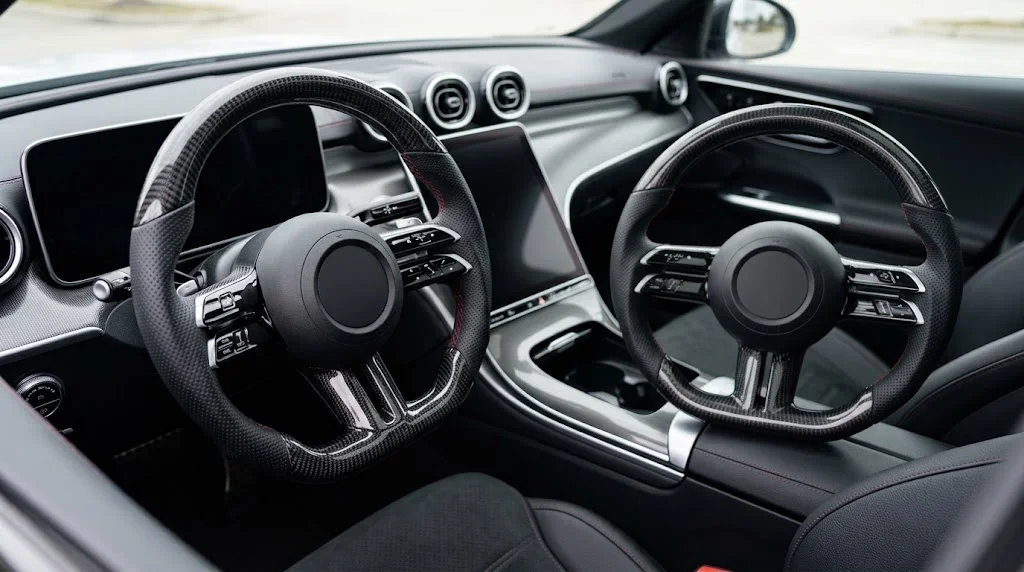
The lower arc is trimmed into a shallow chord. Nothing else moves: the hub, the spokes, the airbag and the button pods stay where they were. What the driver gains is space above the thighs and a visible straight edge at six o'clock.
The edge does more work than it looks. It marks the wheel's centre without a glance down, which helps during a parking shuffle or a quick correction. The flat section sits below the hands on a motorway run, where it is never touched.
A round rim suits a car driven with a light, high grip. A chauffeur-driven S-Class belongs in that group, because the wheel is turned slowly and often with one hand at the base. The continuous arc gives that hand a smooth surface at every angle.
G-Class owners tend to keep the round shape as well. The driving position is upright and the rim is large. Extra thigh room buys little in a cabin that already has space. It also reads as original equipment, which matters to buyers who keep a car standard.
| Attribute | Flat bottom | Round |
|---|---|---|
| Thigh room | More, especially with the seat low | Factory layout |
| Centre reference | Clear straight edge at six o'clock | Relies on the badge |
| Full lock feel | Noticeable as the chord passes the palm | Even throughout |
| Look | Sports, AMG influenced | Standard, discreet |
| Best fit | C-Class, E-Class with AMG Line | S-Class, G-Class, long distance |
The table covers the everyday difference. Nothing in it touches safety, because the airbag and the column are unchanged in either shape.
Put the chord at the top and the rim blocks the instrument cluster. Put it at the side and the hands lose their grip point at nine and three. Six o'clock is the one position a driver rarely holds, so trimming there costs nothing and returns legroom.
That logic comes from competition cars, where a smaller rim and a tight cockpit made thigh clearance a real problem. Road cars borrowed the look and kept the geometry. With the seat set low in a C-Class, the change is felt the first time the driver slides in.
A W205 or W206 C-Class with AMG Line trim is the natural home for a flat bottom. The seats sit low, the console is wide, and the squared arc gives back room that the standard rim takes away. A Mercedes-Benz flat bottom steering wheel fits that brief closely. W213 and W214 E-Class cars follow the same logic when they carry the AMG package.
An S-Class in chauffeur use is better served by round. The rear seat matters more than the front, and the wheel is turned gently. G-Class and GLE owners usually keep the factory shape. A thicker grip section is still worth asking about on a car that tows a trailer over long distances.
An AMG GT or a C63 sits between the groups. Those cars left the factory with a flat bottom in most markets. A rebuild copies that shape rather than inventing one, so the result stays close to what the engineers intended.
Shape and thickness are separate decisions. The rim can be built at the factory section, slightly thicker, or thicker again with a contoured grip at nine and three. A thicker section fills a larger hand and reduces the squeeze needed on a long drive.
Contoured grips add material where the thumbs close. The grip zone on a flat bottom rim sits above the chord, which keeps the palms away from the trimmed edge. Stitch colour and a centre stripe then decide how the rim reads against the rest of the cabin.
Send the chassis number, the model year and a daylight photograph of the rim. Add a shot of the rear face with the airbag out, plus the data card or option list if it is to hand.
Trim decides the airbag, and the airbag decides the cover. An AMG Line car and a standard car of the same year can carry different bags, different button pods and different connector shapes. A heated rim, the Distronic pack and the paddle shifters each add parts behind the cover. Right hand drive cars differ again. Photographs settle these points; a catalog line does not, and no core is cut until the match is confirmed.
Our builds keep the parts that already work in your car. The frame, the pods and the wiring are reused wherever the original hardware allows it.
| Control | Typical outcome |
|---|---|
| Airbag | Original unit reused, cover shaped to suit it |
| Multifunction pods | Kept when the original pods are reused |
| Paddle shifters | Kept; openings cut at order |
| Heated rim | Depends on the mat and control fitted; confirm first |
| Distronic and lane keeping | Read hardware in the rim, so a swap can raise a message |
| AMG Drive Unit | Kept where the rim carries the display pods |
The heating mat and the hands-on sensor sit behind the covering. Each needs its own photograph, since neither can be judged from the front face.
Programming follows the electronics rather than the shape. Reuse the factory module, the loom and the car-specific parts, and the car may need nothing further. Swap in a unit from another generation and the answer can change.
Because that depends on the car, coding is described as a possible step. Pass on the chassis number with pictures of the module and the connector, and we will say whether a workshop visit looks likely. Fitting a heated rim to a car that never had the option is the case that most often needs a workshop visit.
Trouble on these cars arrives with the parts, not the shape. A rim from another generation carries the badge and not the button pods. A heated wheel on a car without the option leaves a connector with nothing to talk to. Distronic reads hardware inside the factory rim, so a swap can bring a warning to the dash. A cover shaped for one bag will not fit a different one. Each case shows up in the photographs before production starts.
Most drivers stop noticing the Mercedes-Benz flat bottom steering wheel within a week. It shows up in two places. One is a full-lock turn in a car park, where the flat passes under the palm. The other is the first glance down when reversing into a space. Neither is a problem, and each becomes familiar quickly.
Cleaning changes a little. The squared corner holds dust where two surfaces meet, so a soft brush reaches it better than a cloth. The corner also takes the most contact from a resting hand on a leather rim. The stitch line there is worth checking a few times a year.
No. The rack and the column are unchanged, so the turning circle stays exactly as it was.
The bag is matched to the car, not to the rim outline. In most builds the original unit is reused inside a cover shaped for it.
Yes, when the core and the airbag allow it. Photographs matter here, because the cover is shaped around the bag your car carries.
Not at six o'clock. The trimmed area sits below the line of sight, and the instrument cluster stays fully visible.
Most drivers report the opposite. A fuller section needs less grip pressure, which helps during slow manoeuvres.
A round rim is the safer choice for a standard car. A flat bottom suits AMG Line cars, where the factory already offered one.
Build takes ten to fifteen working days. Shipping runs fifteen to twenty days. Budget twenty-five to thirty-five days end to end.
The column and the rack are untouched, so the feel through the wheel is the same. Only the point where a palm meets the rim differs.
Usually yes where the mat and its control carry over. Build years differ, so it has to be checked against your car first.
Our workshop in Guangzhou builds one rim at a time, cut and stitched to a specific chassis. Every pattern we cut rests on thirteen or more years of design and production. Shape, thickness and stitch stay your decisions. An aftermarket steering wheel does not automatically void a vehicle warranty under U.S. federal warranty law, but warranty coverage can still depend on whether the modification caused the specific failure being claimed. The federal remedy rules appear in 15 U.S.C. 2304, and the warranty-term rules in 16 CFR part 700.
Two pages on this site go deeper on the cars named above. The C-Class W205 and W206 guide covers the chassis that most often takes a flat bottom. The E-Class W213 and W214 guide deals with the wider cabin and its button pods. Every shape we offer sits in the shop.
Send the chassis number, the option list and two photographs of the rim, and we will confirm which shape the car will take. Two catalog entries show the range. The C-Class and A-Class rim listed across W205, W206 and W211 is built in the factory outline. The forged carbon C63 rim with a twelve o'clock ring carries the squared lower arc. Both are cut to your chassis. Share those details and we will start on your Mercedes-Benz flat bottom steering wheel once everything lines up. Fitment questions can go to the inquiry form or the contact page, and the Mercedes-Benz brand page lists every chassis we cover.
Gloss or matte carbon on a Mercedes-Benz steering wheel? How the two finishes differ in sunlight, cleaning and wear, and which suits your parking situation.
Read More →Carbon fibre, Alcantara or leather? How the three Mercedes-Benz steering wheel materials compare on grip, care and wear, and where each belongs on the rim.
Read More →How to specify a custom steering wheel for a Mercedes-Benz G-Class: fitment across the generations, coverings, coding and the parts to check before ordering.
Read More →